




Architectural Drawings by William A. Bates Return to Bronxville after Decades in Texas
By Eloise L. Morgan, Bronxville Village Historian
Feb. 3, 2016: After 65 years in Texas, dozens of small sketches by William A. Bates, Bronxville's most prolific turn-of-the-twentieth-century architect, have been donated to the village archives by the Bates family.
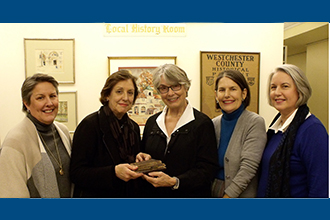
In early January, Bates's four grandnieces, sisters Nancy Wells Warder, Katherine Wells Power, Marianne Wells, and Sarah Wells Macias, traveled to Bronxville to donate the architect's early twentieth-century sketchbooks to the Bronxville History Center. The women decided that after decades in a drawer in their mother's house, "These little books really belonged in Bronxville."
William Augustus Bates was the dominant architectural figure in the early years of Bronxville and its Lawrence Park section, which is now a National Register Historic District. "These amazing sketchbooks are the only original Bates material our archives has," said Bronxville Village historian Eloise L. Morgan. "When Bates died, his office records were left to his partner, an architect, who seems to have left no trace in history other than his work with Bates. Sketchbooks filled with Bates's drawings are a wonderful contribution to Bronxville's history, and we can't thank his family enough for their generosity."
Around 1872, Bates moved to New York City, where he was an architect with Herter Brothers and McKim, Mead & White. In 1890, when William Lawrence began developing Lawrence Park, Bates, who had grown up in Lawrence's hometown of Monroe, Michigan, found himself with a patron who would keep him busy for the rest of his life.
Bates designed most of the early houses in Lawrence Park and was eventually responsible (after 1910 with partner Kenneth G. How) for designing more than 50 private homes, seven townhouse groups, and nine large apartment buildings that still exist in Bronxville. He also helped design several of Bronxville's earliest significant, but now demolished, structures, such as the Hotel Gramatan, the first public school, and the original village hall.
Bates died in 1922, leaving his personal possessions, including the sketchbooks, to his brother, Colonel Charles F. Bates, who lived in Lawrence Park with his extended family, including daughter Frances. Following the colonel's death in 1944, the family relocated to Texas. Frances's four daughters, all of whom still call Texas home, explained that their granduncle's sketchbooks had been in a drawer in their mother's house near Dallas all these years. After her death, her daughters concluded that the books should be in Bronxville.
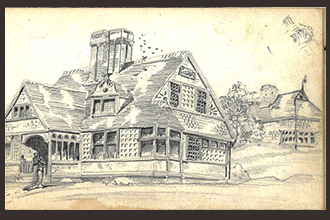
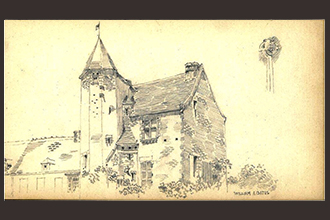
Sketching appears to have been a lifelong passion of Bates. In the 1880s, he helped found the Architectural Sketch Club in Manhattan, where young architects would meet to do sketching exercises over a meal. His leather-bound notebooks, now in the Bronxville History Center, each measuring 4" x 7" or smaller, are "field sketchbooks" filled with detailed drawings of buildings and interior and exterior architectural elements, none of which represents any Bronxville structure.
The Bronxville History Center (previously known as the Bronxville Local History Room), in the Bronxville Public Library, has a collection of published information about William Augustus Bates, including photographs and floorplans of many of his designs that showcased his work in leading architectural periodicals in the 1890s to the 1920s.
The center also holds an assortment of architectural reference books from Bates's personal library. The history center is usually open from 1:00 pm to 5:00 pm on Thursdays (call ahead) or by appointment (914-779-9391).
Pictured here: William A. Bates's four grandnieces deliver the architect's 20th-century sketchbooks to the Bronxville History Center. From left, Sarah Wells Macias, Marianne Wells, Bronxville Village historian Eloise L. Morgan, Katherine Wells Power, and Nancy Wells Warder. Bates was Bronxville’s leading architect between 1890 and 1922.
Photo by Ray Geselbracht
Sketches: Detailed drawings made by architect William A. Bates in small leather-bound sketchbooks that were recently donated by his family to the Bronxville History Center.