


Bronxville's Yellow Brick Road Reopens after Long Restoration: See Video of Dedication
By Carol P. Bartold
Jun. 1, 2016: Rarely does the opening of a refurbished street in any municipality call for a celebration complete with a ribbon cutting, but most streets do not carry the historic significance of Bronxville's yellow brick road.
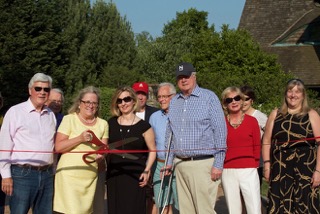
On Wednesday, May 26, at 5:30 pm, representatives from the village and The Bronxville Historical Conservancy officially reopened the restored stretch of Park Avenue from Wellington Circle leading downhill to Tanglewylde Avenue with a ribbon-cutting ceremony.
Faced with having to refurbish this stretch of Park Avenue, known locally as the "yellow brick road," which had suffered a decade of deterioration and disrepair, the Bronxville Department of Public Works planned to pave the street with asphalt. In 2014, The Bronxville Historical Conservancy actively campaigned the board of trustees to maintain the street as a historic brick road.
Through diligent research and many months spent reviewing and testing various brick samples, the Conservancy located a custom brick maker, Colonial Brick Company, in Cayuga, Indiana, whose product would meet Conservancy requirements and pass a stress test. The Conservancy agreed to fund the $102,000 needed to produce 36,500 new yellow bricks. Colonial Brick Company, with only 49 employees, specializes in manufacturing bricks to match buildings and pavements that date back to the early 1900s. Colonial Brick was able to copy Park Avenue's original bricks, manufactured by Porter National near the turn of the 20th century.
The Conservancy's case to maintain the yellow brick road and its commitment to partner with the village for the restoration convinced the board of trustees to restore the street's historic brick paving. In September of 2014, the trustees approved the plan. Conservancy board members played an important role in every step of the planning process to ensure that the new road would retain its historical accuracy while meeting New York State requirements for strength.
The village paid for the cost of building a new road base and installing the new bricks on top of that base. General contracting firm Tony Casale Inc. of Yonkers spent several months building a new solid asphalt base before winter weather set in. Crews from Consolidated Edison addressed needed utility repairs. With the arrival of spring weather, Casale workers laid the newly manufactured yellow bricks to replace the ones that had served as pavers for over 100 years.
According to Bill Dowling of the Conservancy, the project foreman said, "If the previous road lasted 100 years, this new one should last 200." Dowling added that the bricks are so durable because they are three and a half inches thick, about twice the thickness of a typical road paver.
Dowling noted that Mayor Mary Marvin, Village Administrator Jim Palmer, and department of public works supervisor Wayne Ballard not only offered enthusiastic support for the project, but also kept both the Conservancy and Lawrence Park Hilltop Association informed of the project's process "every step of the way."
"It was the model for public-private partnership," said Mayor Marvin, "especially given the government's fiscal constraints. It was also a partnership in respect of the history of our village."
Pictured here (L to R): Bill Dowling, Mayor Mary Marvin, Anne Poorman, Rick Shearer, Donald Gray, Nancy Vittorini, and Dale Walker.
Photo by N. Bower